Tool-Free Cardboard Display Stands: Streamlining Retail POP Display Installation
Discover how tool-free cardboard display stands simplify retail POP display installation, saving time and reducing errors. Contact Meiyastand for streamlined display solutions.
Back to blogs
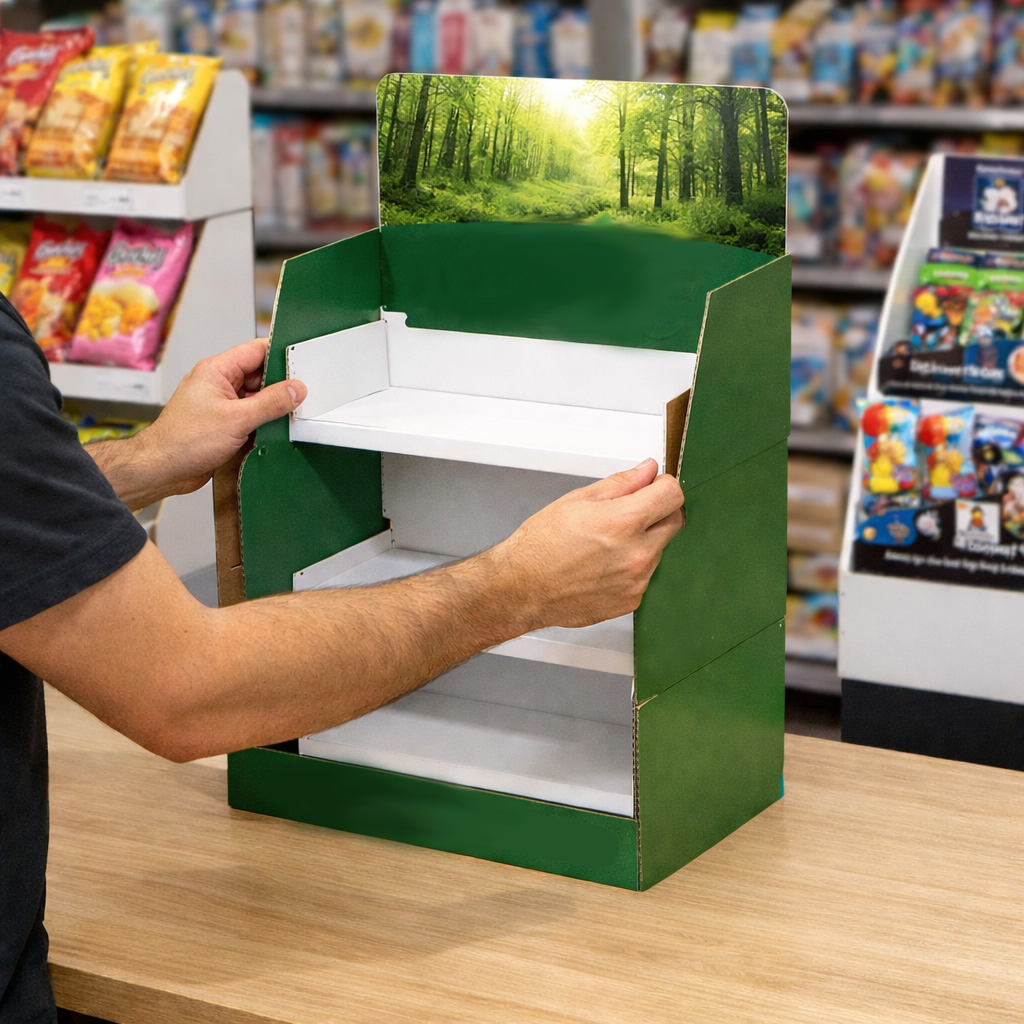
Efficient tool-free assembly designs are transforming how cardboard point of purchase (POP) displays are deployed in stores. These flat-pack displays feature snap-on panels, interlocking tabs, and pre-printed assembly guides, allowing store staff to complete setup in minutes without any tools. For retail buyers and marketing teams, this means faster distribution speeds, lower labor costs, and far fewer installation errors compared to traditional screw or glue based structures.
In real-world applications, tool-free cardboard displays can reduce setup time by up to 75 percent. For example, a case study from SamTop showed that switching trial product displays to snap-on tool free kits cut installation time from 14 minutes to 3.5 minutes, while increasing store compliance rate from 62 percent to 95 percent. These improvements directly translate to more stores launching promotions on time, fewer skipped installations, and higher marketing return on investment (ROI).
Why Tool-Free Design Matters for Retail Displays
Higher Procurement and Installation Efficiency
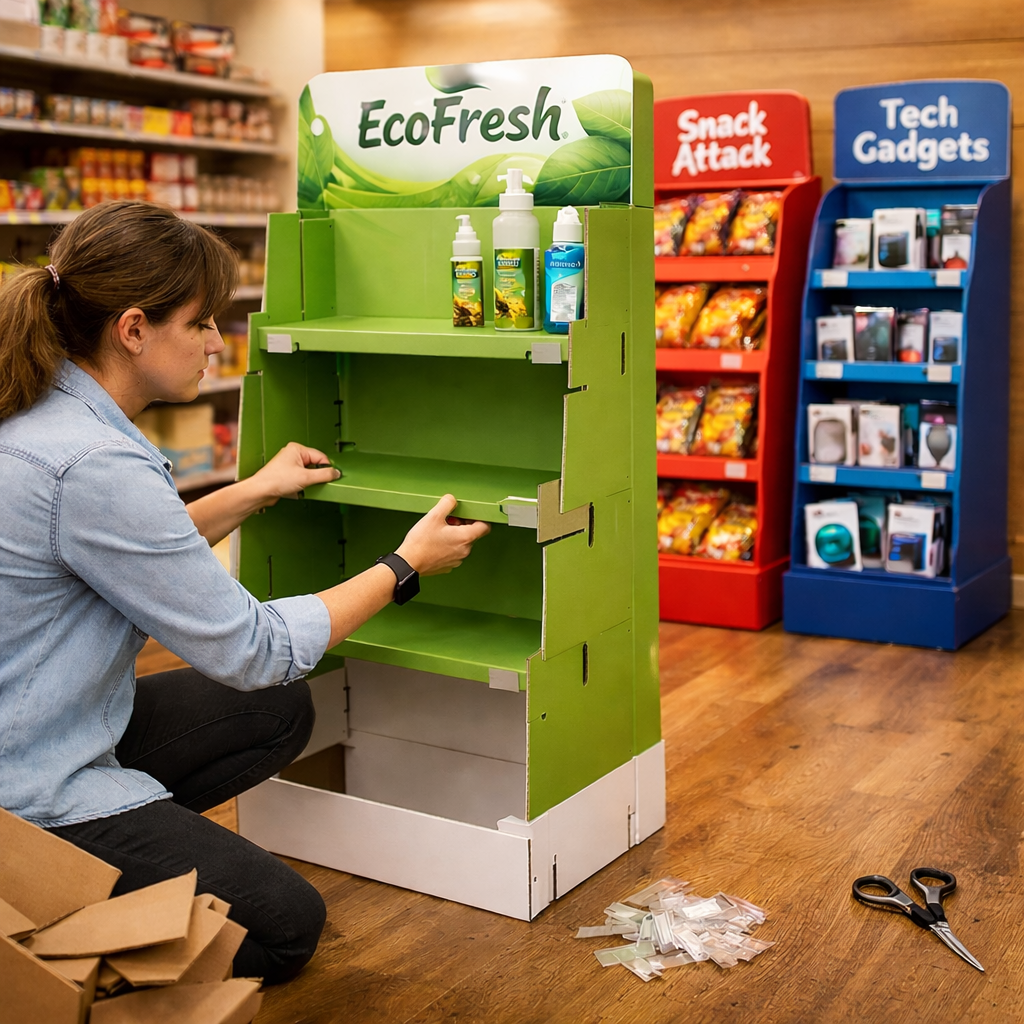
Retail buyers and category managers need display solutions that minimize on site labor pressure in stores. Tool free cardboard displays arrive in lightweight flat pack form and achieve self locking through folding and interlocking. This structure significantly reduces store staff workload: a single employee can usually complete installation independently in minutes, no training or tools required.
The absence of hardware components such as screws and glue also eliminates many common errors. As one packaging design guide notes, complex installations "can frustrate users and waste valuable in-store time" while the solution lies in "intuitive interlocking designs with clear visual guides."
In practice, retailers using tool-free POP kits rarely encounter issues like missing parts or incorrect assembly. For example, with clearly numbered parts and snap-on panels, even first-time users can finish proper installation in 2 to 5 minutes. The end result is clear: store teams can quickly complete display setup without supervision, reducing reliance on professional installers and avoiding missed promotion windows due to installation delays.
Cost Savings and Large-Scale Rollout
Cardboard itself is more cost-effective than metal or plastic structures, and tool free design further amplifies this cost advantage. Displays arrive in compact flat pack packaging, reducing shipping volume by approximately 70% compared to bulky metal displays, thus lowering transportation and warehousing costs.
On-site, installation can be completed by one person alone, saving staffing resources. Shorter setup times also allow staff to focus their efforts on merchandising or customer service. SamTop’s analysis shows that switching to tool-free design reduced installation time by 75%. For chain store networks with hundreds of locations, this translates to thousands of hours of labor saved per promotion.
Meanwhile, brands gain greater product exposure: faster installation and higher compliance rates mean more displays actually make it to store floors instead of sitting in warehouses. As SamTop emphasizes, "The simpler the installation, the more likely your displays are to be set up on time and correctly."
Reducing Errors and Enhancing Consistency
Tool-free systems typically incorporate visual aids to prevent mistakes. A practical approach is to package parts in installation order and print step-by-step guides on outer cartons. Kits can use color-coding or numbered stickers to label each panel, or even include QR codes linking to video tutorials.
These cues significantly reduce the risk of missing parts or incorrect folding. During one promotion, pre-printed "Insert trial products here" sections on panels and pre-assembled graphics eliminated store staff confusion, boosting compliance rates from 62% to 95%. In contrast, displays requiring tools may have an error rate of once every three installations. Clearly, tool-free design not only saves time but also ensures consistent brand presentation, while avoiding additional costs from repeated store visits and rework by merchandising teams.
Value for Marketing Teams and Brand Impact
Faster Campaign Execution
Marketing teams often face tight timelines for product launches and promotional events. Tool-free cardboard displays make campaign rollout faster and more efficient. With little to no training required and installation taking just minutes, brands can complete in-store setup within limited time windows.
As Meiya Display summarizes, cardboard displays are "lightweight, easy to assemble, and readily reproducible, allowing brands to update point-of-purchase (POP) materials promptly without incurring long lead times or high costs." This agility is particularly critical for seasonal or short-term promotions: new campaigns can launch immediately upon product arrival instead of being stranded in backrooms due to complex display assembly.
Enhanced Customer Engagement and ROI
Properly executed displays drive significant sales growth, and the advantages of tool-free structures help brands present promotions as intended in-store. Industry data shows temporary displays can deliver 15% to 25% sales lifts during promotions, far exceeding their production costs. By simplifying installation, tool-free design enables brands to consistently capture these sales increments.
For example, some fashion retailers reported increased customer engagement after adopting sustainable cardboard displays, noting that such eco-friendly fixtures "strike a balance between environmental responsibility and commercial appeal" while providing "tangible data support for brand value." In practice, easier-to-install displays are more likely to be placed in high-visibility locations like store entrances, endcaps, and checkout counters, further boosting impulse purchases.
Sustainability and Brand Image
Today’s consumers care deeply about environmental responsibility, and cardboard displays intuitively communicate a brand’s sustainable values. Tool-free cardboard displays are typically made from recycled materials and FSC-certified cardboard, and can be fully recycled or composted after use.
Reports indicate that a single cardboard display reduces carbon emissions by approximately 46 kilograms over its entire lifecycle compared to metal alternatives. This is highly appealing to eco-conscious customers. Marketing teams can leverage the "warm, approachable texture" of cardboard to convey sustainability messages while maintaining visual impact through high-quality printing.
Lightweight flat-pack packaging further reduces carbon emissions during transportation, as cardboard displays weigh roughly one-eighth of metal ones, minimizing the overall environmental footprint of marketing campaigns. In short, tool-free cardboard displays enable brands to be both agile and responsible: they support rapid in-store rollout while embodying brand values in a single solution.
Key Design Elements of Tool-Free Displays
Effective tool-free point-of-purchase (POP) displays typically share common design principles. Their structures rely on precision slots, tabs, and fold lines, allowing each panel to lock securely without hardware. Snap-fit connections and foldable bases are widely used. For example, many displays feature "tray-style bases" that form via folding and locking, eliminating loose components entirely.
Displays can also be modular, with shelves and top signage that install quickly via slide-in or snap-in mechanisms. High-quality graphics are mostly pre-laminated at the factory to avoid on-site application. The packaging itself doubles as an instruction manual: printed step numbers and product photos inside guide the assembly sequence. SamTop recommends color-coded parts and QR codes linking to video tutorials, enabling staff to complete "foolproof" installation in five minutes.
Typical key design elements include
- Pre-creased folds and interlocking tabs: Strategic placement of die-cut folds and tabs allows panels to lock into place naturally when folded. This interlocking method creates a stable structure without screws.
- Integrated graphics and top signage: Graphics panels and top signage can be integrated into a single cardboard piece or pre-assembled at the factory. Installers only need to unfold the one-piece structure, reducing the number of parts and error risks.
- Packaging as instructions: Print "1-2-3" steps on the inner box or pair labels and images with parts, turning the packaging into a built in guide. No separate paper manual means no risk of loss.
- Simplified structural design: Avoid complex angles and hidden fasteners to make installation intuitive. Complex assembly often frustrates users, so displays should undergo multiple test assemblies by untrained personnel before finalization to identify confusing details.
By integrating these elements, designers can ensure the entire display truly achieves "tool-free assembly with just hands." For example, Meiya Display’s custom cardboard displays minimize tool reliance through structural and engineering optimizations. Every component balances optimal merchandising performance with minimal installation effort, from snap-fit bases to fold-down shelves. The result is that in-store installation teams can get it right on the first try, boosting merchandising efficiency and marketing effectiveness.
Quantifiable Results: Time, Error Rates, and Sustainability
Companies that have adopted tool-free designs report clear, measurable benefits. Key highlights include:
- Faster installation speed
SamTop’s tests show that switching to tool-free structures reduced single store installation time from 14 minutes to 3.5 minutes. GrandFly’s data is similar, with one person needing only about 5 minutes to assemble a single display. - Higher compliance rate
In the same SamTop case, store compliance rate, the percentage of displays correctly installed in stores, rose from 62% to 95%. In practice, when staff can complete installation using simplified designs and intuitive kits, merchandising errors and incorrect assembly are nearly eliminated. - Labor cost savings
Fewer steps and no tool requirements mean significantly lower training costs. Merchandising teams can get started with minimal instructions, reducing the need for technical support, phone calls, and emergency guidance. For large-scale campaigns, accumulated time savings often translate to thousands of hours in labor costs. - Cost and logistics advantages
Cardboard displays typically cost 50% to 60% less to produce than acrylic or metal displays of the same size. They weigh roughly one-eighth as much, and flat pack packaging reduces shipping volume by up to 70%. With the same budget, buyers can purchase more displays or reduce inventory capital occupation. - Environmental impact
Free of metal or plastic, displays are 100% recyclable and often use FSC-certified materials. The approximately 46-kilogram carbon dioxide reduction per display provides procurement teams with a new metric to quantify ROI on sustainability goals. - Warehousing efficiency
When not in use, cardboard structures can be flattened for storage. Research shows this flattening saves up to 90% of warehousing space, making it particularly beneficial for seasonal inventory management and national rollouts.
Overall, these data demonstrate that tool-free design is more than just "convenient", it delivers tangible improvements in efficiency and sustainability. Quantifying metrics such as installation speed, compliance rate, cost, and carbon emissions helps secure budget and internal support for display structure upgrades.
Meiya Display’s Tool-Free Display Solutions
At Meiya Display, we specialize in custom cardboard displays engineered for tool-free assembly. Our structural engineering team integrates these best practices into designs, ensuring every display is pop-up ready right out of the box.
For example, we widely use snap-fit bases and foldable shelves, allowing displays to be assembled in seconds to minutes with no loose parts. Graphics are fully printed and pre-laminated at the factory or designed as one-piece structures, fundamentally reducing on-site graphic application workload for stores. A three-tier floor-standing display with interlocking side panels, for instance, can be assembled by store staff in 5 minutes, saving approximately 10 minutes compared to older display structures.
All Meiya Display units undergo assembly testing: we invite third-party staff to assemble and disassemble samples to ensure even untrained personnel can complete proper installation effortlessly.
Meiya Display also provides end-to-end support for large-scale rollouts. We can bin-label displays by store region and include QR code-linked video or illustrated instructions in each carton as needed. Clients benefit from a full cycle of design, production, and logistics through a single supply partner, ensuring the final displays meet requirements for both installation efficiency and performance.
For B2B buyers, this means the same team handles both creative visuals and tool-free structures, streamlining project communication. We hold FSC, ISO, and other certifications, providing globally recognized environmental and sustainability credentials for your tool-free displays.
If you aim to accelerate retail promotions, the Meiya Display team can collaborate with your procurement and marketing departments to customize optimized display structures based on product dimensions and merchandising standards. You can request a quote or contact our engineering and sales teams directly to explore how tool-free cardboard displays can enhance efficiency and reduce costs in your in-store merchandising. Whether for regional pilots or global rollouts, we offer tailored solutions.
Conclusion: Core Advantages of Tool-Free POP Displays
Tool-free assembly design delivers tangible advantages for retail display projects. By reducing reliance on tools and complex instructions, these cardboard POP displays significantly shorten installation time, minimize errors, and lower overall costs for procurement teams.
Marketing teams gain greater agility to deploy eye-catching, consistent in-store displays faster, boosting campaign effectiveness and sales lifts. Meanwhile, the inherent eco-friendly nature of cardboard displays strengthens brand image, helping businesses achieve sustainability goals.
In short, the ROI of tool-free cardboard displays is quantifiable: faster installation speeds, higher merchandising compliance rates, and improved comprehensive benefits in production and logistics. Partnering with Meiya Display means leveraging these advantages with support from a professional team. Our one-stop service ensures displays are optimized for easy assembly and efficient merchandising from the initial design phase. From concept to delivery, contact Meiya Display today to learn how tool-free cardboard displays can help your brand maximize returns with minimal investment.
Useful Links:
- Structural Design of Corrugated POP Displays: Premium Appearance, Solid Strength
- How to Design Eye-catching Corrugated Cardboard POP Displays
- Understanding PDQ Displays: What They Mean and Why Retailers Use Them
- Floor, Counter, or Sidekick POP Displays: Which One Is Best for Your Product?
- How to Choose the Right Custom Cardboard Display Stand for Your Brand
- Pricing Guide
- Quality Control
- Compliance & Certifications
Latest Posts
All Posts