Cardboard Display Stability: How Product Weight Distribution Affects Shelf Reinforcement and Retail Safety
Stable cardboard displays start with balanced product weight, reinforced shelves, and safe load planning for real retail environments.
Back to blogs
Cardboard displays often look stable when fully stocked and newly set up. But real retail use is different. Products are picked, moved, refilled, and sometimes pushed to the front of the shelf. That's why display stability isn't determined by total product weight alone.
A display may hold products safely when the load is evenly arranged. Yet the same structure can sag, lean, deform, or tip when heavy items are placed too high, pushed to the front edge, or concentrated on small contact points.
For brands planning cardboard POP displays, product weight distribution should be reviewed before the structure is finalized. The supplier needs to know not just how heavy the products are, but also where the weight sits, how the products make contact with the shelf, and how the display will actually be used in stores.
Why Total Weight Isn't Enough
Many projects start with one question: how much weight can the display hold? That's useful, but only a starting point.
Two products with the same total weight can create very different pressure. Soft snack bags typically spread weight across the shelf. Glass jars, cans, bottles, and dense cosmetics often press down through smaller, harder bases. This can cause shelf dents, crushed flutes, or front edge bending, even when the total weight looks acceptable on paper.
That's why a professional display project should confirm unit weight, product base size, products per shelf, product layout, and the expected restocking method. These details help decide whether standard corrugated shelves are sufficient, or whether the display needs stronger board, shelf liners, internal supports, or honeycomb panels.
Center of Gravity Affects Display Stability
Center of gravity has a direct impact on retail safety. The higher the heavy products sit, the easier it is for a floor display, dump bin, sidekick display, or tall freestanding unit to become unstable.
For heavier products, more weight should usually be placed on lower shelves and closer to the center of the structure. A wider base, balanced shelf layout, and internal bracing also help the display stay stable during customer interaction and daily restocking.
This is especially important for beverages, canned food, pet products, household items, glass packaging, and dense skincare or cosmetics. In these cases, good design should control where the weight sits, not just how thick the board is.
Point Loads Need Load Spreading
Point loads happen when product weight is concentrated in small areas. Bottles, jars, cans, tubes with hard caps, and products with narrow bases often create this problem.
If each item presses directly onto the corrugated shelf, the board may weaken over time. A shelf liner, double-layer board, laminated support area, or honeycomb insert can help spread pressure across a wider surface.
This type of local reinforcement is often more practical than making the entire display heavier. It supports the areas that carry the most pressure while keeping the display cost-efficient, easy to ship, and practical for store setup.
Front Edge Loading Is a Common Retail Risk
Many cardboard displays look stable when fully stocked, but problems can appear after products are partially sold. One common issue is front edge loading.
This happens when products are pushed toward the front to keep the display looking full, or when customers remove items from the back and middle rows first. As the remaining stock moves forward, the shelf front begins to carry more pressure. The front lip may bow, products may slide, or the shelf may sag.
To reduce this risk, the structure should help control product movement. Useful details include proper shelf depth, front retaining lips, side dividers, angled trays, product stops, and clear fill guidance. These details help the display stay organized both when it's full and when it's half empty.
Choosing the Right Reinforcement
Reinforcement should match the real risk. Adding more material everywhere can increase cost and shipping weight, but it may not solve the actual problem.
For general load capacity, the display may need stronger corrugated board, double-wall board, or thicker shelf construction. For point loads, shelf liners or honeycomb panels can help spread pressure. For wide shelves, internal columns or folded supports can reduce sagging. For tall freestanding displays, a wider base, lower product placement, and anti-tip structure may be necessary.
The best reinforcement plan isn't always the heaviest one. It's the one that solves the right structural problem while keeping the display practical for production, transport, assembly, and retail use.
Store Conditions and Testing
Cardboard displays are used in real retail environments, not perfect test rooms. Humidity, storage, transport handling, floor cleaning, and restocking behavior can all affect performance.
Corrugated board may lose stiffness near wet floors, open doors, refrigerated areas, or humid stockrooms. Handling can also reduce strength if shelves are bent during setup, locking tabs aren't fully inserted, or products are loaded unevenly.
Prototype testing is essential for heavy or dense products. The sample should be tested with real products, not just empty shelves or estimated weights. The test should check shelf sagging, front edge bending, product sliding, base stability, and performance after partial unloading.
Fully loaded, half loaded, front loaded, and unevenly loaded conditions often reveal risks that a perfect display photo cannot show. If the prototype shows permanent bending, crushed shelf areas, unstable movement, or visible stress marks, the structure should be adjusted before mass production.
What Brands Should Confirm Before Production
Before approving a cardboard display for heavier products, brands should provide product size, unit weight, packaging format, product base shape, units per shelf, total display load, expected layout, store placement, campaign duration, transport method, and whether the display will ship flat or pre-packed.
These details help the supplier choose the right board grade, shelf structure, reinforcement method, and prototype testing plan. A counter display for lightweight cosmetics may only need simple dividers, while a floor display for glass bottles may need reinforced shelves, stronger side panels, a deeper base, and load testing with real products.
With this information, the display supplier can create a structure that balances visual presentation, load capacity, shipping efficiency, and retail usability.
Conclusion
Cardboard display stability depends on product weight distribution, center of gravity, shelf support, store conditions, and daily handling. For brands planning cardboard POP displays, the key principle is simple: keep heavy products low, spread concentrated loads, avoid excessive front edge pressure, and test with real products before mass production.
A well-designed cardboard display should look good at launch, stay organized during daily shopping, and remain structurally reliable throughout the retail promotion. For brands preparing a new retail campaign, confirming product weight and placement details early can help avoid redesign, improve prototype approval, and make the final display more reliable in-store.

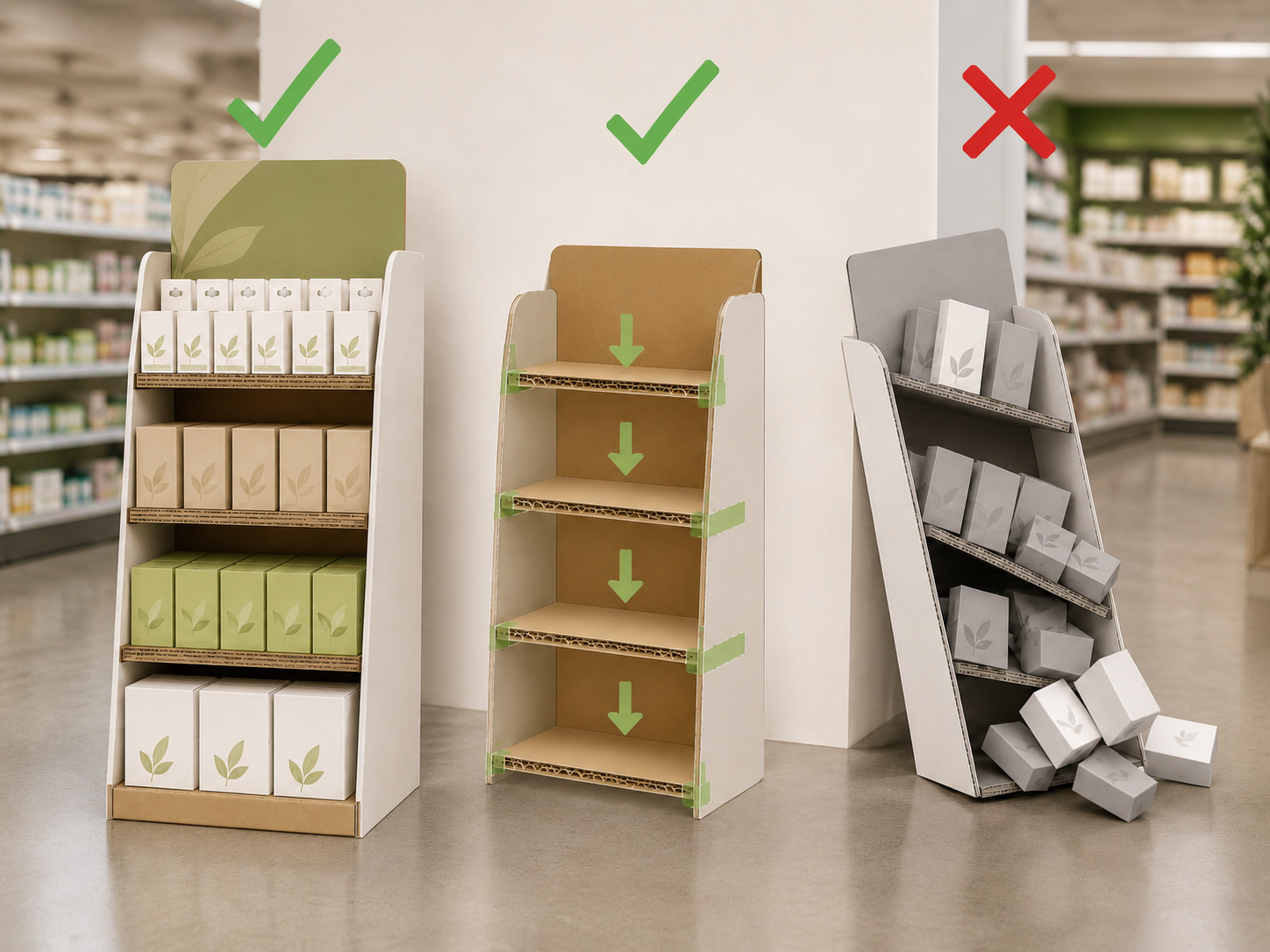
A stable cardboard POP display designed with reinforced shelves, balanced product placement, and a strong base for safer in store merchandising.
Useful Links:
Latest Posts
All Posts